Applied Coating of: Danish Oil.... Installed Front Latch.

Installed a Pair of Brass Hinges. Finished inside with Green Felt.
 Finished inside with Green Felt.
 Finished inside with Green Felt.

When it comes to Asian “Tea Ceremonies” I divide them into three (3) distinct regions; China Mainland, Taiwan and Japan. This not a complete representation, but it is my personal experiences they demonstrate the range to which tea making and serving extends.
Japan, demonstrates the highest level of importance to the adherence of ceremonial dictates. Simply stated: Ceremony first, tea taste secondary. Great importance is placed on the; tea growing, picking, processing and storage.
A woodblock print by Toyohara Chikanobu depicts a tea ceremony during the reign of the Meiji Emperor. At this time tea was part of etiquette training for women.
(2 of 3) Taiwan has a foot in both China and Japan when it comes to tea. I see interesting adaptations and personalizing in making and serving. Tea rises to the forefront with adaptable ceremonies.
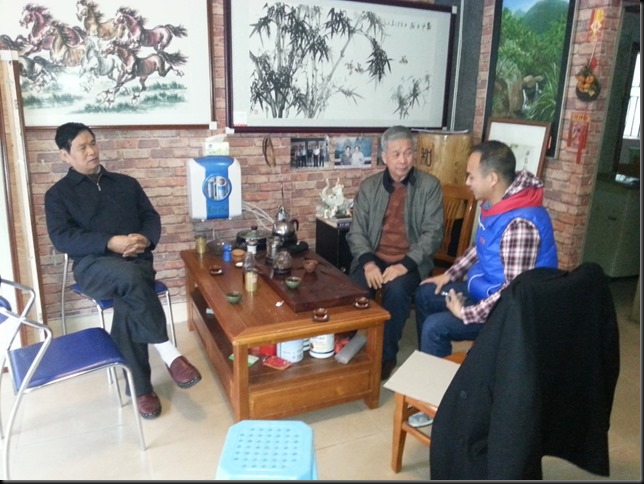
My Taiwanese friend’s tea table.. a typical business meeting is centered around having tea and sharing ideas.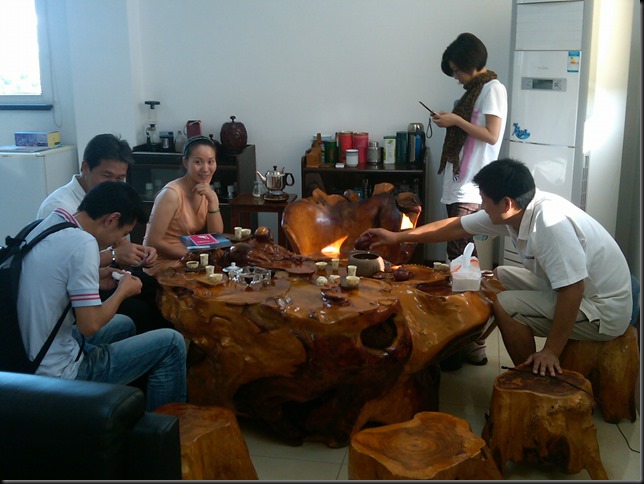

(3 of 3) China Mainland, enjoys a fabulous diversity in the brewing, serving and sharing tea. The physical size and diversity of peoples in China plays into regional variations. The common denominator: Tea is first and foremost.
Typical family/friends having tea.


Staff writer, with CNA, NEW DELHI

Chatime (日出茶太), a Taiwanese bubble tea shop, is scheduled to open its first Indian outlet in New Delhi tomorrow, tapping into the younger-generation market by offering the Taiwanese specialty beverage also known as pearl milk tea.
After opening its first outlet at the Metropolis shopping center, Chatime plans to set up another one in Gurgaon, about 30km south of the capital, in the near future.
Chatime, which operates more than 750 outlets in about 50 cities in 15 countries around the world, including the US, Australia, China, Singapore, Philippines, Indonesia and Malaysia, said it was aiming to open a total of 150 outlets in India over the next five years.
GROWTH POTENTIAL
Henry Wang (王耀輝), chairman of La Kaffa International Co (六角國際), which owns Chatime, told reporters in New Delhi on Wednesday that with India’s long history of tea drinking, it offers great potential for growth of new tea drinks like bubble tea, adding that Chatime is targeting the 15-to-30 age group.
MIDDLE EAST
He said Chatime also looked forward to bringing bubble tea to the Middle East in the future.
Representative to India Philip Ong (翁文祺) told a news conference that he was delighted to see bubble tea finally getting a presence in the fast-growing South Asian country.
‘NEW PAGE’
Ong said Chatime is the first Taiwanese investor from the service sector to make inroads into India, a move that has turned a new page in business ties between the two countries.
India-based Alchemist Group, which serves as the agent for Chatime’s tea products, said all of the tea and other ingredients for Chatime’s Indian outlets would be imported directly from Taiwan.
Wang said although India was suffering widespread power outages, it had affected the manufacturing sector more than the service industry

Staff writer, with CNA
A group of Taiwanese agricultural experts and tea professionals are ready to put the reputation of the nation’s oolong teas on the line by organizing a “World Oolong Tea Contest.”
The competition, scheduled for Dec. 25 to Dec. 28, will be open to anyone with a product made from Chin-Shin oolong tea leaves, Lin Chih-huang (林志煌), chief executive of the Taichung-based Taiwan Outstanding Agriculturists Association, said yesterday.

There are few restrictions on entry, Lin said, adding that applicants are only required to send 1kg of tea produced this year to the organizer.
“We welcome people from countries where Chin-Shin oolong is grown to join the contest. We also hope that many Taiwanese will sign up for the competition, which is aimed at singling out the world’s best of the best oolong tea,” association secretary-general Huang Ta-tsung (黃達聰) said.
Huang said the group hoped publicity from the competition would help expand the market for oolong tea and promote Taiwan’s high-quality oolong tea in international markets.
Association chairman Liao Lung-sheng (廖龍盛) said Taiwan has produced about 20,000 tonnes of tea in the past few years, including about 16,000 tonnes of the oolong variety.
However, Taiwanese tea farmers are coming under growing pressure from competitors in neighboring countries, such as China and Vietnam, Liao said.
In 2010, Taiwan imported more than 30,000 tonnes of tea, more than 80 percent of which came from China and Vietnam.
“Taiwan needs to make more of an effort to promote its world-renowned oolong tea,” he said.
“The enthusiasm of Taiwan’s tea farmers in developing planting and tea-making techniques is the key to making Taiwanese tea one of the world’s best,” he said.
Liao described Chin-Shin oolong, the variety used to produce most of the world’s premium oolong tea, as a delicate tea plant species that grows best in high-altitude mountainous areas covered by moist fog — conditions that are found in Taiwan.
Registration for the tea contest will be open until Nov. 30.
Taiwan highland tea breaks into Chinese market
2011/08/31 20:44:26 
Taichung, Aug. 31 (CNA) An order for 2,326.8 kilograms of Taiwan highland tea was shipped to retailers in Jiangsu Province in China on Wednesday, marking the largest sale to China for Li Shan tea farmers.
The order was placed in mid-August when Taichung City officials visited Changzhou City in Jiangsu Province, one of the major tea consumption areas in China, according to the Taichung City Agriculture Bureau.
The bureau said Chinese people are quite taken with Taiwan's highland tea, especially the fragrant variety from Li Shan in central Taiwan that has a nice finish because of the high altitude.
After having tasting Taiwan's highland tea, Chinese retailers in Jiangsu placed an order for NT$11 million (US$379,250) worth of tea and requested that it be delivered as soon as possible, the bureau said.
Tea trees have better soil and water conservation attributes than fruit trees, therefore, if the sale to China is a success, the bureau will start assisting fruit farmers in the Li Shan area to switch to tea, said Tsai Ching-chiang, Chief of Agriculture Bureau for Taichung
Taipei Times Story: Staff Writer, with CNA (pictures from web)
People in Germany are now able to have a sip of authentic Taiwanese tea and enjoy its famed bubble milk tea, a local teashop chain said yesterday.
With a stated goal of becoming “the Eastern Starbucks,” the Taipei-based Comebuy teashop chain has almost achieved its aim of extending its reach to six countries outside Taiwan, with outlets in China, Singapore, Malaysia and Indonesia in addition to the imminent Berlin opening, and with plans for a Japanese presence approaching the final stages.
The grand opening of its first German store in Berlin on Sunday last week made it the first Taiwanese teashop chain to set up in Europe. “We’d like to introduce good Taiwanese tea to our foreign friends,” said Sam Lin, executive director of Comebuy International Co (長沅國際實業). http://comebuy2002.com/ 
Many similar local businesses have expressed interest in the European market, but so far only Comebuy has set up a store after meeting strict EU standards, he said.
Besides strengthening training and tightening quality control, Lin said his company had to rebuild its “tea espresso machine,” which cost NT$120,000 (US$4,134), to allow it to get the “Conformite Europende” mark. As is the case with other overseas shops, there will also be subtle changes to the flavors and packaging of many of its products to suit German consumers.
“For our Berlin store, we’ll have products specially flavored with yogurt,” Lin said.
Established in 2001, Comebuy opened its first teashop in Taiwan in 2002, but has since switched its business focus to overseas markets. Besides setting up in Germany’s largest city, the teashop chain is planning to gain footholds in the UK, France and the Czech Republic, Lin said. “In fact, India is also one of our extension options,” Lin added.
Comebuy currently has 92 stores in Taiwan and 59 outlets overseas.
Tea farmers dismiss tariff cuts
TEA TEASE: Although tea farmers are not interested in the tariff cuts, they are worried about poor quality tea from overseas being marketed as Alishan tea
STAFF WRITER, WITH CNA
Monday, Sep 13, 2010, Page 12

Workers pick tea leaves in Mingjian Township, Nantou County on Tuesday. A cross-strait trade pact that took effect yesterday and will bring tariff cuts next year has not cheered Taiwanese tea farmers, who are more concerned about the rising imports from China of pesticide-contaminated tea.
PHOTO: HSIEH CHIEH-YU, TAIPEI TIMES
A Taiwan-China trade pact that took effect yesterday and will pave the way for tariff cuts from next year has not cheered Taiwanese tea farmers, who are more concerned about rising imports of pesticide-contaminated tea from China into Taiwan.
Although China is Taiwan’s largest tea export market, Lin Yu-ping, one of Taiwan’s many small tea farmers, believes it is unlikely that local farmers will be able to sell their premium products in China.
“Taiwan does not produce quality tea in large amounts and cannot even meet local demand,” she told the Central News Agency in a telephone interview on Saturday.
Yeh Hsin-zhong, a tea farmer on Alishan (阿里山), one of the country’s noted tea production areas, also made similar remarks.
“There is limited production of Alishan tea due to a lack of available land. How can we export to China when we can barely satisfy local demand?” he asked.
Their remarks came just before the Economic Cooperation Framework Agreement (ECFA) signed between Taiwan and China in late June formally came into force.
The landmark trade pact between Taipei and Beijing will kick off a first round of tariff reductions or eliminations on hundreds of items between the two countries from Jan. 1 next year.
Under the trade agreement, a 15 percent tariff on Taiwanese tea exports to China will be reduced to zero step-by-step in the next three years.
The Taiwan Tea Exporters Association (臺灣區茶輸出業同業公會) has predicted a 30 percent growth in the volume of Taiwanese tea exports to China due to the ECFA.
Taiwan exported 2,375 tonnes of tea last year, which accounted for only 14 percent of total production.
The association’s president, Yvonne Kao (高毅芳), attributed Taiwanese people’s strong demand for local tea to the low export volume.
China is Taiwan’s largest tea export market, with 791 tonnes recorded last year — 33.3 percent of the total exports — followed by the US and Japan, official figures show.
The upcoming tariff cuts, however, do not appeal much to tea farmers like Yeh, who said that local tea is already in hot demand in China.
Yeh expressed concern over the growing amount of lower quality tea from China and Vietnam being fraudulently marketed in China as Alishan tea.
“This problem is becoming serious. Sometimes, there are even complaints from Chinese tourists about buying fake Alishan tea,” he said.
The fake tea problem prompted sales in Mingjian Township (名間) in Nantou County to plunge late last year when tea products from the township sold by the National Palace Museum were reported to contain pesticide residue.
To counter the problem, Wang Chao-kun (王招坤), chairman of the Alishan Tea Production Cooperative (阿里山茶葉生產合作社), urged the government to impose clear labeling on the origin of foreign tea imports.
Another problem facing Taiwanese tea farmers is their peers, who exported high-end tea-cultivation expertise to China years ago.
“These Taiwanese businessmen took tea seedlings, technology, machinery and experienced specialists from Taiwan to China,” Lin said.
Lin blames the government for its past failure to prevent Taiwan’s tea production expertise from going to China.
 My friend in Taiwan provided these links. (thx. Shawn) .. some fantastic images ...
 Teatime at the National Palace Museum
 I purchased mine during a visit to Taiwan .. sold in the "high end" tea-pot store in the Ying Ge ..The Parrot (InGa) shopping district, about 45min from down-town Taipei.
Story from today's Taipei Times:
The gondola to Maokong will whisk you away from Taipei, bringing you and throngs of others to a sanctuary of teahouses and natural beauty — and the views aren’t bad either
By Mac William Bishop
CONTRIBUTING REPORTER
Thursday, Jun 19, 2008, Page 13
As you look down from the tea fields of Maokong, Taipei stretches away to the horizon
Even on a rainy weekday, dozens of people queue in front of the Maokong Gondola (貓空纜車) before it opens at 9am, waiting to be carried from the bleakness of daily life into a haven of green hills and breezy teahouses.
Since it first opened on July 4, 2007, the Maokong Gondola has carved out a niche as one of Taipei’s “must-see” attractions.
Maokong (literally “no cat” in Mandarin), in the foothills of Taipei City’s Wenshan District, is said to derive its name from a Hoklo homophone that refers to the rugged, craggy topography of the hills, which resemble cat footprints.
The area is known for its tea plantations and accompanying teahouses, and has long been a popular getaway for local residents. However, the treacherous approach — narrow and winding beyond the norm for mountain roads in Taiwan — was a hindrance to exploitation of Maokong’s tourism potential.
The Maokong Gondola is visible nestled among the hills in the foreground, while Taipei 101 stands out on center right
For this reason, Taipei City Government began construction of the gondola system in partnership with the French firm POMA in 2005.
Despite some initial misgivings about its reliability and the usual complaints and opposition that accompany such large-scale infrastructure projects, the Maokong Gondola has been a success in terms of popularity and its impact on local businesses.
It’s no surprise, either. With stunning views of Taipei framed by verdant hills, Maokong offers a blend of natural and man-made diversions that few areas so easily accessible from Taipei City have to offer.
Even on a weekday with poor weather, tourists flock to Maokong. Here, they wait at Maokong Station to descend via gondola back to Taipei
Part of the draw is the area’s rich history as one of the centers of Taiwan’s tea industry.
TEA IS KING
Maokong is surrounded by tea plantations and filled with teahouses.
The main reason local tourists are flocking to Maokong is to indulge in Chinese “tea culture” at its finest.
The entryway to the Big Teapot Tea Emporium, a teahouse in Maokong, is decorated with the traditional accessories of the tea grower, from sandals and hat to collecting baskets.
As you exit the terminal Maokong Station, one of the first things you will see is a veritable wall of signs indicating different places to visit in the area. The bulk of the signs are for teahouses.
You will also find a number of billboards posted around Maokong showing three walking tours — red, blue and yellow — which are a combination of streets and footpaths with teahouses, shops and other attractions liberally dispersed along the route.
The best teahouses in Maokong will give you a combination of good food, great tea and relaxing views with a nice breeze and clean environment. Given that there are more than 40 teahouses in Maokong, the location and the quality can vary widely.
The Taipei Promotion Center for Tie Kuanyin and Pachung Tea hosts events and classes on the tea industry of Maokong
As you look for a teahouse that suits you, you will have time to enjoy the views of Wenshan District’s tea plantations. Wenshan is renowned for two types of oolong tea: tieguanyin (鐵觀音) and baozhong (包種) teas.
Tieguanyin (Iron Goddess of Mercy) and baozhong are examples of oolong tea, although baozhong is often described as one of the lightest of the types and very nearly a green tea.
As with most famous types of tea in Chinese culture, there are several myths and historical stories attached to these brands, some more picturesque than others.
Nowadays, the finer examples of these two types of tea can sell for upwards of US$500 per kilogram — more per gram than some types of illicit narcotics.
This, of course, points to one of the driving forces behind Maokong and its tourism — an effort to protect the economic interests of an agricultural sector.
As with farmers throughout the country, Taiwan’s tea growers are concerned about increased competition after Taiwan’s accession to the WTO in 2002, as well as a general downturn in Taiwan’s tea industry.
So if drinking tea is (ahem) your cup of tea, Maokong will be heaven.
For some insights into the technical side of the tea industry, you may want to check out the Taipei Promotion Center for Tie Kuanyin and Pachung Tea (台北市鐵觀音包種茶研發推廣中心), just down the road from Maokong Station. The center has a tearoom, agricultural demonstrations, as well as displays of equipment from the tea-growing industry and various teas and tea-drinking accoutrements.
WALKING AROUND
Steeping yourself in tea culture need not be the only reason to go to Maokong. Just unwinding and enjoying the views while riding the Maokong Gondola is itself a welcome diversion from city life.
There are several public hiking trails in the area, some of which are better maintained than others. Innumerable dirt trails wander between and through tea plantations, but as most of these are on private land, your presence may not be appreciated.
Forests of camphor trees, perfuming the land with a pleasant scent, surround the plantations. You will also commonly encounter Taiwan acacia, Chinese hackberry and king’s fig.
Meanwhile, as you ascend into Maokong in your gondola car, listen for the distinctive cries of the colorfully plumed black-browed barbet.
Crested serpent eagles are also frequently heard. They can be commonly seen floating on the thermals rising between the hills, keeping a watch for unwary lizards or basking snakes.
As you glide above them, the sounds of the city begin to fade and you start to relax — assuming your companions in the gondola car are not screaming and sighing as though they are on a roller-coaster ride. Even if they are, you’ll probably forgive them.
It is easy to be charitable while floating above Maokong’s hills.
If you go: Getting there:
From Taipei Main Station, take the MRT Bannan Line to Zhongxiao Fuxing station, and transfer to the Muzha Line. Take the Muzha Line south to its terminus, Taipei City Zoo station. Depart from exit No. 2. The Maokong Gondola’s Taipei Zoo Station is a five-minute walk away.
Several buses will take you near Taipei Zoo Station, including No. 236, No. 237, No. 282, No. 294, No. 295 and No. 611; Brown No. 3, Brown No. 6, Brown No. 11 and Brown No. 15; Small No. 12 (小12號); and Green No. 1.
Ample parking is available near the Maokong Gondola’s Taipei Zoo Station.
Maokong Gondola:
You can use a Taipei City EasyCard to pay for the ride, or purchase tickets at the station. A single, one-way fare from Taipei Zoo Station (動物園站) to the terminal Maokong Station (貓空站) is NT$50.
The one-way journey from the bottom to the top (just over 4km) takes around 20 minutes, although expect to wait in line for 20 to 30 minutes both ascending and descending at most times. Waits may be considerably longer — an hour or more — on holidays and weekends.
Hours of operation:
Monday: Closed
Tuesdays through Fridays: 9am to 10pm (last ascent is at 9:30pm)
Weekends and holidays: 8:30am to 10pm (last ascent is at 9:30pm)
Teahouses:
There are dozens of teahouses in Maokong, so your best bet is to wander into a place that looks pleasant. Teahouses typically offer a variety of snacks and standard dishes representative of Chinese cooking in Taiwan. The big draw is the tea: most will have a selection of green and oolong teas, varying in price from NT$120 to NT$380 for a standard tea service. Fine teas become progressively more expensive in accordance with their rarity.
Here are two locations near Maokong Station with good selections of tea and excellent views:
Big Teapot Tea Emporium (大茶壺茶棧)
37, Ln 38, Zhinan Road Sec 3, Wenshan Dist, Taipei City
(台北市文山區指南路三段38巷37號之1)
Telephone: (02) 2939-5057
Hours: 11am to 6pm or later (depending on amount of custom)
Mountain Water Inn (文山客)
10, Lane 40, Zhinan Road Sec 3, Wenshan Dist, Taipei City
(台北市文山區指南路三段40巷10號)
Telephone: (02) 2234-1239 or (02) 8661-9421
On the Net: www.ample.com.tw
Hours: Open 24 hours a day
Other food and refreshment:
The gondola stations have a variety of concessionaires offering the standard snacks and refreshments one will find anywhere in Taiwan, from milk tea and fruit juice to lunch boxes and sandwiches.
There are also numerous street stalls immediately outside of Maokong Station, offering a slightly wider variety of typical Taiwanese street food.
Arrived Taipei Wed. afternoon .. no travel problems. NOTE there was an additional security check leaving Shenzhen before entering the immigration / customs area. Only for dual registration vehicles.
Taipei at this time of the year reminds me of Paris .. it just does, filtered sunlight, tree lined streets .. busy sky's .. a general lightness is the air, feels good.
Wed. evening, unfortunately Dawn (Tim's girlfriend) was studying for a French language examination, so just Tim and I for dinner at the Miramar Garden, great meal, a special thank you to: chefs Andy Chiang and John Hu.
Taipei 101 at the: Lower Right Pushpin .. Miramar; upper left.
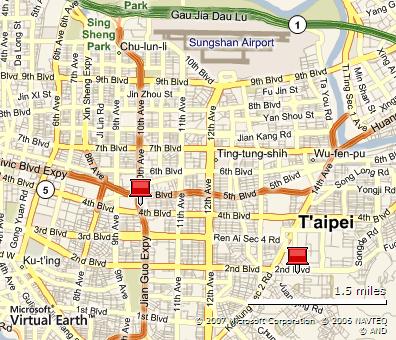
Thursday, most of the morning at the factory .. afternoon: a stop at YingGe .. then off to San Yi
Ying Ge ..The Parrot, hard to miss this place..

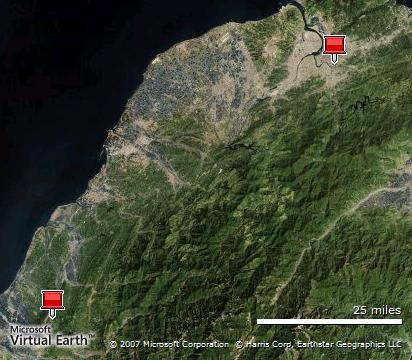
The weather was just perfect with mix of clouds, strong sun, refreshing breezes and NO rain...(unlike Paris) SanYi; the epi-center of Taiwan wood carving. 


 On Saturday the park is a makeshift thrift market.
 Wang's family tea business.
 Wang's has a relationship with the government to help maintain and promote Taiwan tea making and selling.
 She runs this store, 1 of 3, but only this one has the tea processing factory.
 Inside the factory area .. sorting out the stems
 The old roasting bays and some old hand tools:...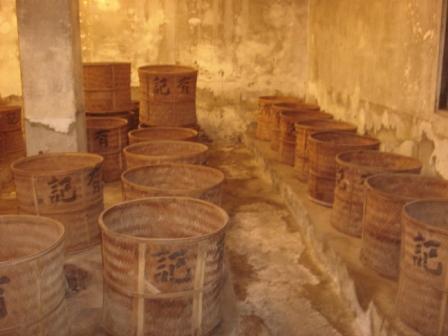
 Some retail sales:...