A short two weeks in China just flew by. China continues to be an amazing place that must be experienced first hand.
Tea: Retail buyers; numbers are dwindling. Retail / Wholesale shops are dealing to move on-hand stocks. A couple of months back a: Four pack of Puerh bricks selling at 3,000 RMB .. now at 1,700 RMB. My tea purchase totaled about 2,300 RMB, for a healthy supply.
Sunday, February 26, 2012

Tuesday, January 31, 2012
The Blur Named: January
Well January is, was and is no more.
Robbie spent most of January in the Philippines, diving. .. A few recent Macro photos .. nice stuff


Heather & Jake made it back to Hawaii .. The car we shipped over also made it ..
I’m off to China in a few days.
Sunday, January 29, 2012
China Daily .. Tea news stories
Changing contours
Updated: 2012-01-06 08:55
| By Lin Jing, Hu Meidong and Tan Zongyang (China Daily) |
|
The Wuyishan government plans to build the city into a major tea production base, with an annual tea processing output of 200 million yuan by 2015. [Wei Yongqing / for China Daily] |

|
Wuyishan has 592 companies and 958 family workshops that are engaged in tea production. [Chen Hao / for China Daily] |

Tea growers in Wuyishan brewing organic recipe to overcome productivity, pricing hurdles Wuyishan, a county-level city in Nanping, northwest of Fujian province, and named after the Wuyi Mountain, acts as a natural boundary between the Jiangxi and Fujian provinces and is the cradle of most black teas in the world.

Steeped in rich history, the misty and verdant mountains of Wuyi are set to sport an organic hue that not only promises to bring in the tourists, but also keep the cash registers ringing for tea growers. Tea has been one of the most important exports from China for several years now with the Wuyi blends being the pride of choice among connoisseurs of Chinese tea.
Black tea is one of the major components of global tea trade and accounted for 66 percent of the some 4.06 million tons of tea produced in 2010, according to the latest available figures from the China Tea Marketing Association. Exports of black tea stood at 1.3 million tons in 2010, and accounted for nearly 75 percent of the global tea exports. Nearly 44 percent or 40,000 tons of the black tea produced in China comes from Fujian, especially from the Wuyi Mountain.
In spite of these impressive figures, black tea exports from China currently are less than 5 percent of the global total. Stiff competition from other growing nations on the pricing front and stringent quality controls imposed by importing nations have queered the pitch for many tea growers in China. But things are set to look up again for tea growers as consumers across the world are becoming more health conscious and turning to products with more natural ingredients.
The city has 592 companies and 958 family workshops that are engaged in tea production. Many of them have already turned to organic cultivation with an eye on the future. Tribute Tea Co is one of the first local companies that pioneered organic tea farming in Wuyishan. Yu Zeqin, general manager of the company, says that the Wuyi Mountain is particularly suitable for organic tea cultivation.
"The temperature difference in the mountain range is huge during day and night, which makes tea trees less vulnerable to diseases and pests. Hence it needs less pesticide and fertilizers," Yu says. Established in 2007, the company has 35 hectares of organic tea gardens in the Wuyi Mountain, with 90 percent of its employees being tea farmers.
"Tea is a special commodity. Its price and profit varies based on the quality," says Yu, adding that better quality will help tea growers have a better say in product pricing. Some tea growers have seen their revenue grow five-fold after getting an organic certification, he says. The local government has also taken several steps to encourage organic planting and invested 22.1 million yuan ($3.5 million, 2.7 million euros) to build a 2,800-hectare organic tea garden in the city.
According to the city's 12th Five-Year Plan (2011-2015), Wuyishan plans to build a tea technology center with an additional investment of 600 million yuan. The center will take up an area of 13 hectares and serve as a tea trading and logistics hub, help to standardize tea production systems, perform product quality testing and provide technical support for the Wuyi Mountain tea to go global. Over the next five to 10 years, Wuyishan plans to become the provincial tea production base, with an annual tea processing output of 200 million yuan by 2015.
During the 12th Five-Year Plan period, the provincial government will spend more than 30 million yuan every year on the tea industry, especially in tea resources protection, building an organic tea garden and tea testing institutions, mechanized production and promotion. It also aims to encourage at least three tea companies to get listed on overseas bourses and two in China.
Much of the shift toward organic tea growing in Wuyishan was triggered due to the low yields and productivity. "Low productivity has always been a major hurdle for tea growers in Wuyishan," Liu says. Spread over 2,798 square kilometers, Wuyishan has just 87.4 sq km of tea gardens, and produced 9,770 tons of tea in 2010. In contrast Sri Lanka, with 2,500 sq km of tea gardens, produced 399,000 tons of raw tea in 2010.
"Every year we receive big export orders, but we cannot cater to these orders due to our limited labor and productivity," says Kang Liyun, marketing manager of Lapsang Tea Industry Co. Established in 1998, Kang's company has 130 employees and produces 600 tons of tea every year. The company ships about 100 tons of unprocessed tea to the European Union, the United States, and some Asian countries such as Japan and South Korea. It also has two processing factories, spread over an area of 4,500 sq m. Apart from the tea gardens in Hubei and Jiangxi provinces it owns, it also has alliances with local tea gardens and processing factories.
To further enhance its productivity, the company has sought 20,000 sq m of land from the local government to build a new processing factory. The total investment in the new facility is expected to be about 60 million yuan and if permitted, would increase production by three to four times.
"We plan to build a modern factory to help standardize our processing and shorten the production cycle." At the same time exporters are also facing higher risk as tea-consuming countries in the West are raising the testing standards. Last year, the European Commission issued an order that seeks to impose special control measures on tea imports from China.
The directive calls for stricter examination of China's tea exports to the EU including entry into the EU through designated ports and also stipulates that 10 percent of the goods should have on-site inspection and sampling tests for pesticide residues and other items. Shen Qing, chief executive of King Building, a Beijing-based company that specializes in industry planning and marketing, feels that most of these directives are technical barriers. He says that Sri Lanka exports about $1.2 billion worth of tea every year. Most of its products are up to the standards of most consuming countries.
"China should strive to have stricter quality control in its tea garden management and producing system. It may reduce the productivity to some degree temporarily, but the quality may increase by a large extent, and so will the overseas sales." Export price is another issue that concerns domestic producers. A report from China Tea Marketing Association shows that the average price of Chinese tea in the world market is about $2 per kilogram, 40 percent lower than that from India and 60 percent lower than tea from Sri Lanka.
In the domestic market, the average price of black tea is about 150 yuan per kilogram. A kilogram of Jinjunmei, a top variety of black tea, is priced at 7,200 yuan to more than 20,000 yuan. Wei Saiming, general manager of Fujian Tea Import and Export Co, says that stricter testing in the EU may increase export costs to some extent, but the real hindrance for growing exports is the low profits in overseas markets due to inadequate pricing. "Right now the domestic market is more lucrative for tea producers with its high revenue and low market threshold. On the other hand, to satisfy the strict requirement of the EU, tea producers have to apply a series of quality control measures from the use of pesticide to final processing method. It all pushes up the cost and management risks for tea makers."
In October 2011, Michael Bunston, chairman of the International Tea Industry Committee, along with tea experts from tea councils in the Canada and the United Kingdom, introduced a Wuyi Mountain proposal at the International Tea Conference & Tea Products Trade Fair 2011.
The proposal aims to reposition Wuyi Mountain tea in the world tea industry and find a way to enlarge its market share and build up its reputation. It has also suggested that the local government and members of the tea industry protect Wuyi Mountain's tea culture and tea varieties, and encourage them to sustain their efforts through organic cultivation, in such a way that Wuyi Mountain tea will sell in the EU on the basis of WTO terms and EU standards.
Yang Jiangfan, president of Wuyi University, says that for Chinese tea to be popular in the West, the first priority is to increase the prevalence of Chinese tea culture. "Wuyi Mountain tea has its own features and own geographic characteristics and historical foundation. Local companies should combine it with their products so as to better promote Wuyi Mountain tea in the overseas markets," says Yang, who is also managing director of the China Tea Society.
Yang says that the different consumption habits also result in diverse markets at home and abroad. "For most agricultural products, the better ones will be exported. But for tea, most of the better products are sold in domestic markets." Yang says that Western consumers treat tea as a daily drink. Thus they prefer the convenience and standardized tastes of teabags. But for Chinese people, they endow tea drinking with cultural significance and enjoy the complicated process of tea making. "Tea tasting is a special phenomenon in China. Chinese people have the habit of drinking high quality tea and are willing to pay a higher price for them while foreigners would buy normal tea, as long as it is up to a certain standard."
Yang emphasizes that to change the current export structure, the international market should also be further explored. "Unlike beer or cola, tea drinking has profound cultural elements through its packaging, tea making and tasting. Foreign consumers need to be educated to understand and appreciate the meaning behind it."
Finding the right flavor
Updated: 2012-01-06 07:45
| By Lin Jing (China Daily) |

After opening its first tea trading office in China, Finlays, the London-based major independent tea trader, is now eyeing other sectors of the tea industry in the country.
"For the moment we are just a trading office. But there is a lot of land and potential here for tea growing. If we move onto to the growing and processing side, we will think about opening a second office here, so that we can better cover the Taiwan, Hong Kong and Southeast Asia markets," says Sally Henderson, general manager of Xiamen James Finlay Trading Co Ltd.
According to data from Bosi Data Research Center, an industry research firm, annual sales of bottled tea drinks in China grew from 34.3 billion yuan ($5.44 billion, 4.21 billion euros) in 2006 to 48.2 billion yuan in 2010. Henderson says that the huge market potential for bottled tea will pep up demand for tea extracts in China.
"Earlier, Finlays used to import tea extracts from factories in Chile and Kenya for making the beverage in China. Since China is capable of making similar products, Finlays will consider more investments in the tea processing sector," she says. Headquartered in London, Finlays has 11 tea trading offices around the world, including the newest one in Xiamen, East China's Fujian province. Some of them are in consuming countries and some in tea growing countries. "Finlays has been trading tea with China for 25 years, and it is really hard to understand the market from outside. That is why we set up an office in Xiamen to know more about the local industry and build up connections," Henderson says. But she says that the Xiamen office is different from other offices. It will export Chinese tea as well as import tea extracts from overseas.
"Finlays' office in the United Kingdom and the United States focus more on dealing with customers, while the offices in Hanover and Jakarta are more in the tea export business. The China office is planning to do both, exporting Chinese tea leaf and covering tea extract business in Asia-Pacific." Founded in 1750, Finlays became a wholly-owned subsidiary of the Swire Group in 2000. It is one of the leading tea traders in the world, with trades of over 100 million kilograms every year. What drew Finlays to Xiamen was its geographical position and the good foundation of the tea industry.
"Fujian has tea, tea experts and traders along with good connections to markets in Southeast Asia and Hong Kong. Xiamen also has local tea research institutes and scientists, working on the betterment of the tea industry." Though there have been reports of rare earth and pesticide contamination in Chinese tea recently, Henderson is not unduly perturbed.
"Everything we export or import will be analyzed in our laboratory in Germany, to make sure the tea sample is up to the requirement of different standards in different markets." "We will also select tea with the support of our worldwide network. If we select tea for exports, we will send samples to other Finlays offices in the target countries and check what is suitable for their customers there."
For export, instead of high quality tea, the company is looking at the lower grade green and broken black tea from Zhejiang, Hunan and Hubei provinces, mainly for industrial processing in the Western countries.
She says when foreign buyers look at Fujian tea, they tend to fall into two groups, with most buyers from Europe and Russia wanting special and high quality tea in small volumes.
The bigger volume comes from low quality and cheap tea that goes to the US for the iced tea business, with some even going to the EU for blending or as tea bags. "Because of the low quality Chinese black tea is very light and does not have strong character. But it becomes good after blending with tea from other countries or adding certain flavors." Though Finlays is still in its early stages, the company is looking at Chinese tea exports of over 1 million kilograms every year.
Henderson has been in the tea business for over eight years now, first in London as a tea buyer and then in Hong Kong. In March 2011, she relocated to Xiamen to help set up the Finlays office. Personally, she is also a big fan of Chinese tea.
"When I was a student in Taiwan, I had oolong tea for the first time and really remember the unique taste clearly." She likes both black tea and Tieguanyin, an oolong tea produced in Anxi county in Fujian province. She also likes Biluochun and Longjing green teas from Zhejiang province.
What she likes most about Chinese tea is its taste and spiritual enjoyment. "Drinking tea makes me feel better and healthy. Making tea is relaxing as well. You can sit down and have a chat with your friends. I am not sure whether I can get along with people who do not drink tea," she says. "Also, the tea trade is a nice industry to work in, involving lots of people and travel. They are passionate, and willing to go out of the offices and into the field."
Finlays has its own tea gardens in Kenya and Sri Lanka, covering more than 39,000 acres (15,800 hectares) and produce 40 million kilograms of black tea each year. It has already started its flower growing business in Songming county, Yunnan province in 2007. Today, the Yunnan Taikoo Flowers farm has a production area of 9.5 hectares, growing over 12 million stems of carnations per annum.
Though the Chinese operation does not grow tea right now, it will be on their agenda in the future, Henderson says. "Having our own tea garden is something we will definitely think about seriously." She says that over the next few years, supply would not be enough to cater to the demand and many tea companies are looking to augment their tea sources.
"Countries such as Kenya do not have a stable political climate and are also prone to extremities like drought. So it is better to expand our tea gardens in other countries." Henderson says China is suitable for growing tea due to its low labor costs and environment. The company considers inland regions such as Hubei and Sichuan provinces as ideal locations.
"With our own tea production, we will have full control of tea sources and quality, and do not have to worry about contamination issues." "China is exporting a very small proportion of its tea production. With so much expertise and land for growing tea, there is no doubt that China will soon play an increasingly important role in the global tea industry," Henderson says.
Saturday, December 31, 2011


Saturday, December 17, 2011
The “BEST”
The old adage: “One man’s meat is another man’s poison.” As we each expound the various subjective virtues of one tea over another .. It is exactly that; an individual subjective preference (or rejection) of said tea.
My two favorites are now in the land of Unobtainium (less stock on hand)…. So ..2 Days, about 10 hrs of tea tasting with a goal of finding a Pu-Erh tea. Near the end of day two (Sunday).. Mrs. Yang quietly made a pot and served it up, nothing said just filling the cups and moving on. it was love at first sip. I could not contain my excitement and declared an unsurpassed tea was being presented to us (8 folks in total) Needless to say we extended our say for a few more rounds.
Leaving the store Mrs. Yang gave me gift of the only box she had, with a promise of more to come.

Unbiased by packaging this “Non-Pressed” tea with 10 years of maturing flavor is quite simply the best tea I have had the pleasure to drink.

Hong Kong .. In and Out
Time fly's when your having fun. Sunday and Monday in HK were, despite the cold temps (8-10), very pleasant, clear skies and clean air!!!!.

Thursday, December 08, 2011
Hong Kong–China–Singapore
Changes in the tea business .. Retail sales slump .. shop closures etc .. and the rise in prices with high end products being offed … a strange mix to ponder. Lee Hong a friend of 7+ years with her “boyfriend” He studied Tea in university and now works in the retail / teaching store in Dongguan


Tuesday, November 22, 2011
Tea Room Art – Hokusai
Two new additions to my tea room. Very reminiscent of Hohusai’s Tsunami 

Friday, November 04, 2011
Archeology 101 and beyond
Re-Embanking on a previously abandoned dig of my youth … The Large Samoan construction mafia occupy my side-yard .. Archeology, the precursor to an anticipated construction project.
Tangible progress, as day fades to night. Plans for more concrete progress ensue.


“THERE are fairies at the bottom of our garden!
It's not so very, very far away;
You pass the gardener's shed and you just keep straight ahead” – more accurately the site of our future gardener’s shed.
Now my Thanksgiving holiday plans are “set” .. off to the lumber yard. Time to erect a Folly
Tuesday, November 01, 2011
For those in inclement Northern Latitudes

No warmth, no cheerfulness, no healthful ease,
No comfortable feel in any member -
No shade, no shine, no butterflies, no bees,
No fruits, no flowers, no leaves, no birds -
November! ~ Thomas Hood
Monday, October 24, 2011

Monday, October 17, 2011
Underwater, in more ways than one
Pygmy Seahorse, Robbie continues her SCUBA safari.

From my friend Rick in Thailand:
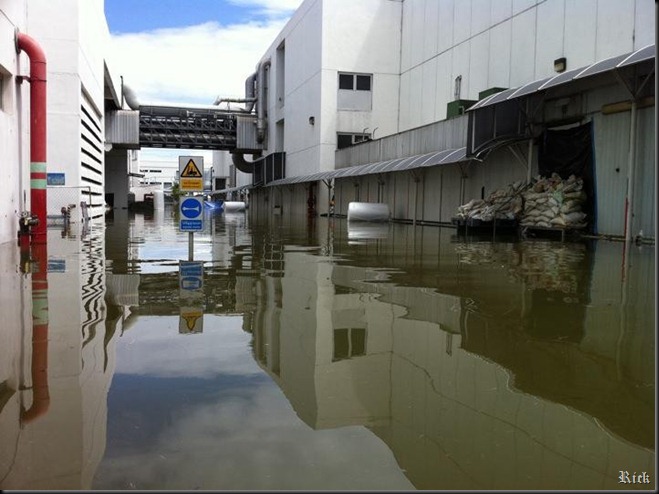
“Here in Chiang Mai there was some flooding around the town but I didn't have any trouble right at my house... (good thing) But it made travel to work adventurous a couple of days and one day I left early from work just to be sure I could get home. I live on the west side of a river that runs North and South through town and where I work is on the east side of the river. A couple of the major ways across the river were flooded and not passable for a couple of days but I was able to take alternate ways which unfortunately everyone else had to do the same so traffic, which is always pretty congested due to Thailand's poor infrastructure was even worse for those days. But all that happened a little over a few weeks ago and since then there hasn't been much rain in our part of the country. But around Bangkok and a few other Providences it's a different story as this has been some of the worst in recent history. “
“I just received these pics this morning. They are from the High Tech Industrial Park just north of BKK where I used to travel to Pemstar. These buildings shown are Hana Microelectronics, the CM my company uses today..... I'm at the Chiang Mai facility but they have a couple in and near the BKK area.”


From my friend Rick in Thailand:
“Here in Chiang Mai there was some flooding around the town but I didn't have any trouble right at my house... (good thing) But it made travel to work adventurous a couple of days and one day I left early from work just to be sure I could get home. I live on the west side of a river that runs North and South through town and where I work is on the east side of the river. A couple of the major ways across the river were flooded and not passable for a couple of days but I was able to take alternate ways which unfortunately everyone else had to do the same so traffic, which is always pretty congested due to Thailand's poor infrastructure was even worse for those days. But all that happened a little over a few weeks ago and since then there hasn't been much rain in our part of the country. But around Bangkok and a few other Providences it's a different story as this has been some of the worst in recent history. “
“I just received these pics this morning. They are from the High Tech Industrial Park just north of BKK where I used to travel to Pemstar. These buildings shown are Hana Microelectronics, the CM my company uses today..... I'm at the Chiang Mai facility but they have a couple in and near the BKK area.”


Wednesday, October 12, 2011
Stuff and more Stuff
Robbie is now in Anilao .. couple more weeks and she will head home.


I’ve managed to add another notch on my hammer .. The “Oak and Birch” is officially open or closed for business.


A full restoration is well underway on the 106 year old Sewing machine case work. As a centenarian, time and usage have left their mark. Disassembly to component parts, some judicial cleaning and repairs, should see us good for another hundred years.
Old fasteners: . back in the day when “slotted” screw heads were the only offering.


Thursday, October 06, 2011
Stuff …
Scientists are nibbling at our foundations, can we achieve speed in excess of: 299,792,458 m/s. I would say that its relatively easy, what is not, is to travel faster than an ever evolving list of “Things To Do”
Andrew stopped by for a few hours on Saturday. In town for a wedding (not his) then back to Texas on Monday .. major score for me .. Pair of Oakley Livestrong Jawbones .
.

Robbie is off globe hopping .. LA to Manila to Singapore to Jakarta to Manila to Anilao to Manila to LA .. About a month of SCUBA .. some pics:…..


Let’s see if the upcoming long weekend can make a dent in that list of projects. If you resonate to these terms you know the plan ahead: Threshold, Jamb, Head Jamb, Stop, Hanging and Casing.
Wednesday, September 21, 2011
A stitch in time saves nine.
Three FedEx packages, 46.6kg. What could it be?
Clue #1: Least said soonest mended.
Clue #2: It’s the Singer not the song.
Clue #3: A Greek Tragedy, Euripides Eumendides
Friday Sept. 23rd. Update:……..
All is now revealed … What is behind Door #3 …..
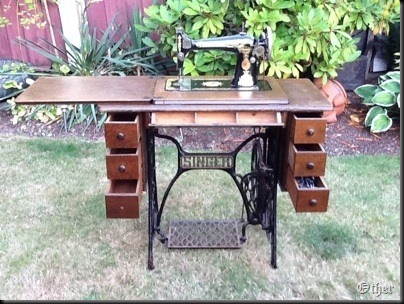
An 1899 Model 27 K / 28 K, cordless, wireless, HPTSM

Human Powered Treadle Sewing Machine. Manufactured by: Singer Manufacturing Company, between 1899 and 1913.The ultimate in “Going Green” and getting Off the Grid.



Clue #1: Least said soonest mended.
Clue #2: It’s the Singer not the song.
Clue #3: A Greek Tragedy, Euripides Eumendides

Friday Sept. 23rd. Update:……..
All is now revealed … What is behind Door #3 …..
An 1899 Model 27 K / 28 K, cordless, wireless, HPTSM

Human Powered Treadle Sewing Machine. Manufactured by: Singer Manufacturing Company, between 1899 and 1913.The ultimate in “Going Green” and getting Off the Grid.


Subscribe to:
Posts (Atom)