Saturday, April 14, 2018


Friday, April 13, 2018


Thursday, April 12, 2018
Something's just tickle the funny-bone
Posted by YT woodworker on a social media posting.
“π r2 “.. “NO !! Pies are round, Cornbread are square.”

Tuesday, April 10, 2018
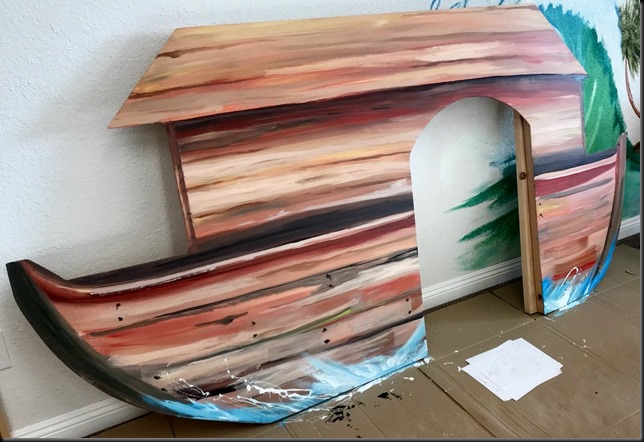
Build an Ark … You need Clamps UPDATE
Not everyone’s cup of tea … But !! after 39 days of heavy rain you might just wish you had one

All painted, ready for the kids to use.


Sunday, March 25, 2018
Tea BAG storage ….
Tea bags are truly ubiquitous .. When in the mood for a cup of EBT (English breakfast tea) Yorkshire Gold is “my cup of tea” … Packaged in 160 bags per box.

Lacking bulk storage for said tea bags .. Time to put that to rights.
“The best wood to use, is the wood you have” With this in mind, I mined some suitable material and hardware.
I have came up with material to produce a practical solution, letting the Tea Bag: shape/size/quantity dictate caddy size. 12” x 4” x 3” is what came about for the internal dimensions and using 1/4” material we have a utilitarian box. A plain box/caddy not unlike the humble tea bag.


Monday, March 19, 2018
“Time to talk of many things.” … aka Tea Time
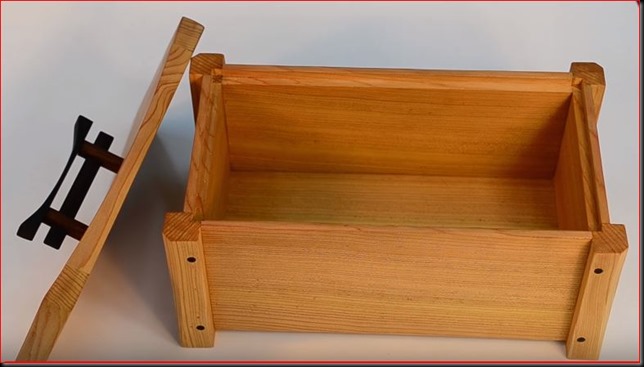
Resurrection of a delayed project … A new Tea Caddy …
Late last year I started mulling over designs for additional Tea Storage. I now have a design that will form a basis to expound on: A Japanese sashimono box, joinery without glue or nails … just well fitted joints held with wooden friction pegs and wedges. … source Harry T Morris on YT.
https://www.youtube.com/watch?v=XVeAZ-fjRWc&t=80s


Friday, March 16, 2018
Once I was a baby Crib, now I’m a ……
Using / Re Purposing baby crib material .. once crib slats . now Legs


Wednesday, March 14, 2018
It’s the simple things ….
Woodworker, users of glue .. at some point you shake and wait as captured contents eases into to the spout … OR NOT…
A dofur made from wood off-cuts(scraps)

Having a prototype, I’ll modify a few details and produce one for shop use.


Thursday, March 08, 2018
A Stitch in time saves umpteen. .. Asian Re-Binding
Re-Stitching/Binding an Asian style book is relatively simple. (not something I do on a regular basis) Having taken apart one of my three copies to facilitate scanning the pages, time to reassemble the said book.
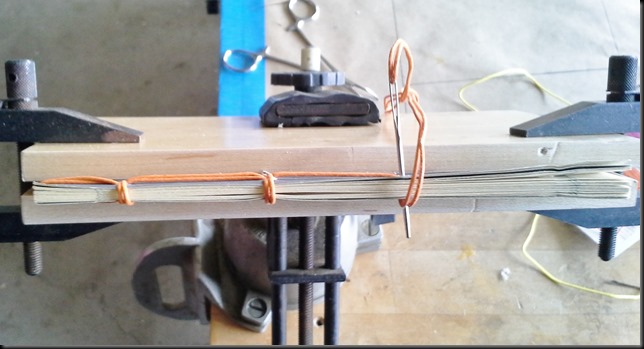
A few aids: a pair of thingmabobs held in a watchamacallit clamping the pages
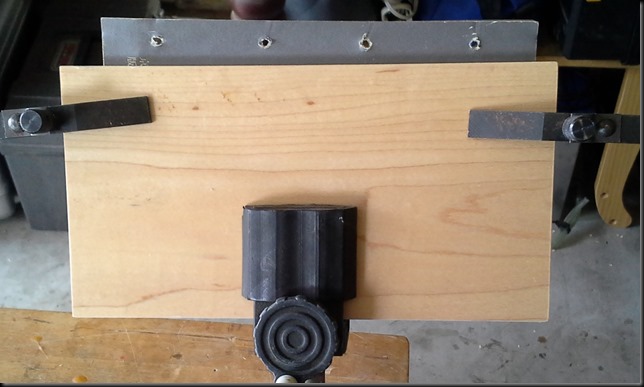

A borrowed Tapestry Needle really makes short and sure work of stitching.


Wednesday, March 07, 2018
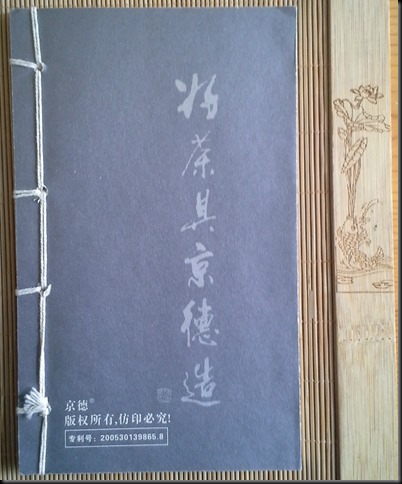
Book Anatomy
A typical Asian 4-Hole stitched book binding, intended to be read in reverse, as to a Western style book. Turning pages to view the book is similar to viewing a long horizontal scroll. This revels the simple ingenuity of the book design and construction. Photographs below:
Front Cover, spine binding on the Right

Back cover of the book.
Inside Pages Two and Three … Right to Left
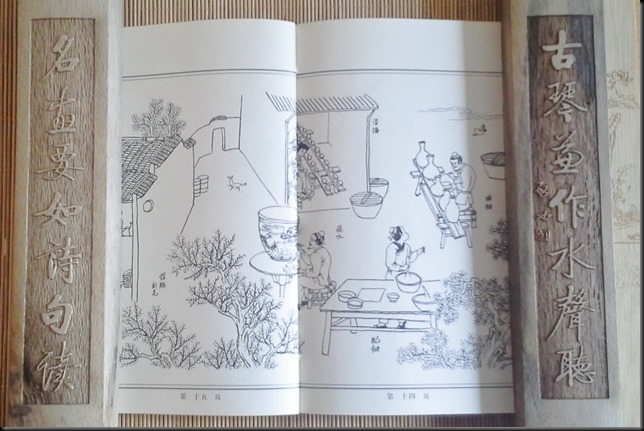
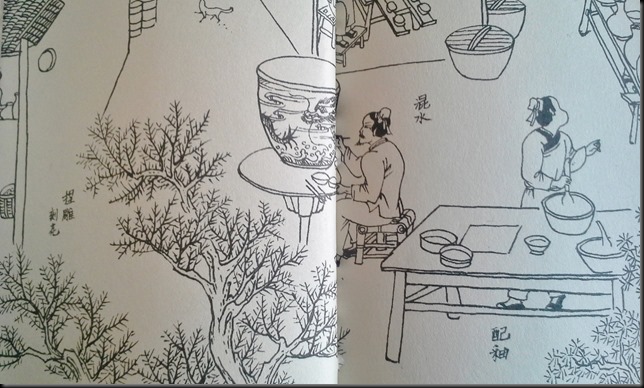
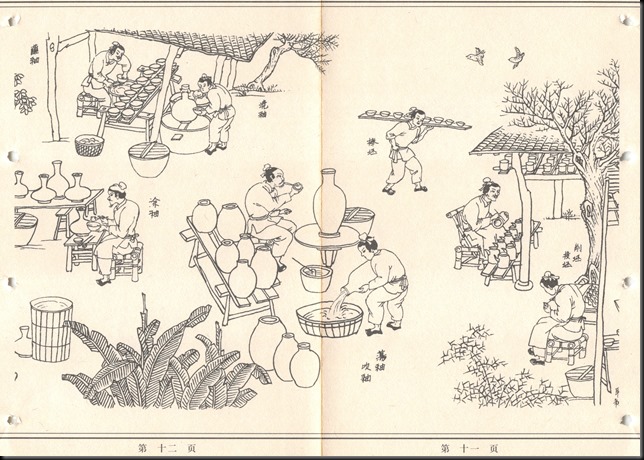
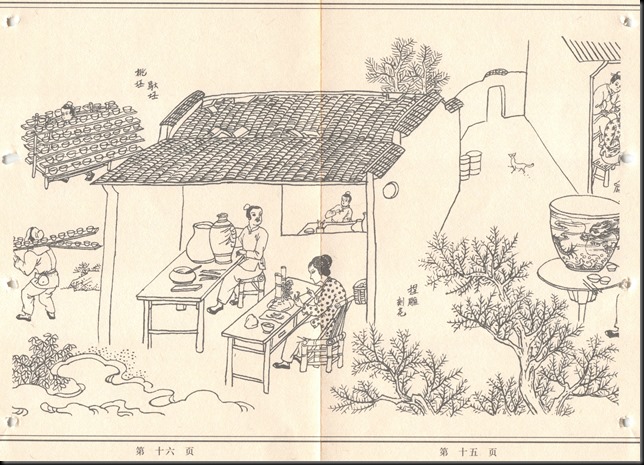
Making Pots … “Back in the Day”
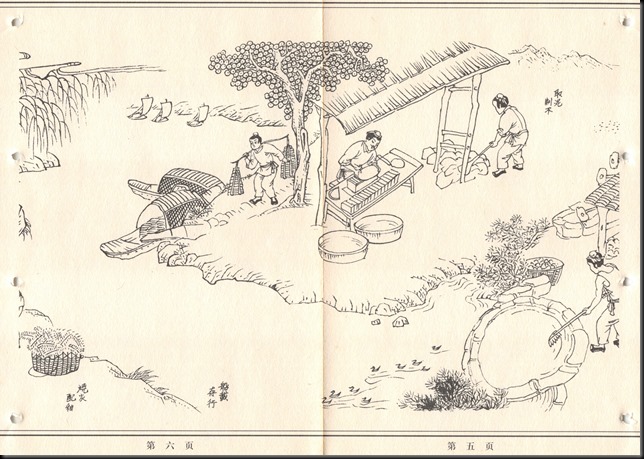
Images from an old hand stitched Chinese book.
Pages 3 thu 24 show: amassing materials, processing materials, pottering around, packaging for river shipment and accounting with the accountant. Each sheet folded at the center, with each half sequentially numbered, eg 3-4, 4-6 etc. Reminder: read from Right to Left

More on the book anatomy in a future posting.







Sunday, February 18, 2018
A White Paper ..
Ozu Washi instructor Nao Tanaka demonstrates how to pick up a film of pulp that will eventually dry into a sheet of paper.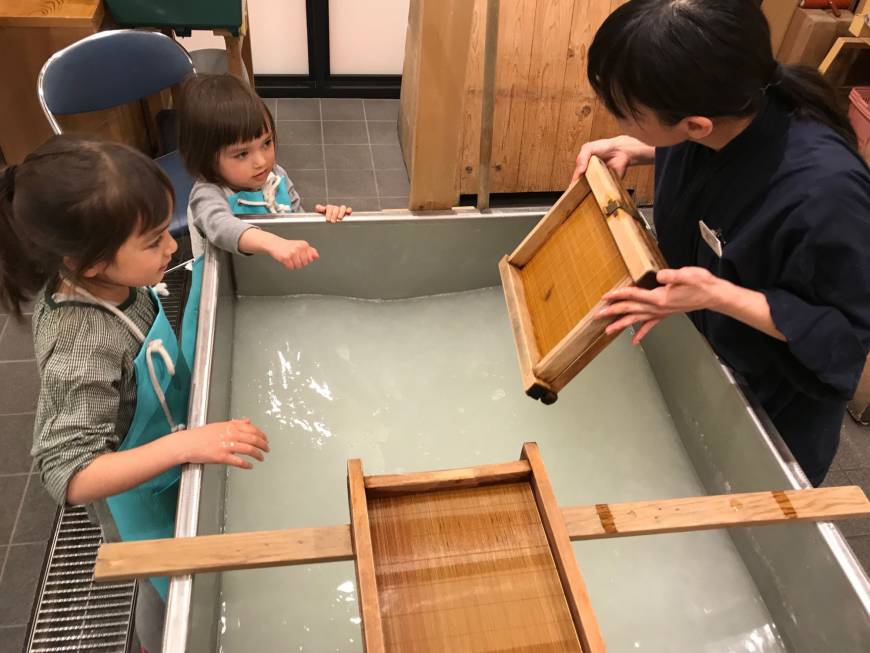
‘Mummy, where does paper come from?” This was a question recently asked by my young daughter that was easier to answer than her usual string of what's and whys (“Do insects cry?” and “Why were we born?” among them).
On this occasion, I was not only able to tell her with confidence that paper most definitely came from trees, but I also managed to take her and her sister to a workshop to learn precisely how to make it.
The class took place at Ozu Washi, a multi-story emporium that impressively dates back to 1653 and is devoted to all things related to the art of traditional washi (Japanese paper) .
It’s one of a string of thriving centuries-old family businesses that can be found hidden among modern towers and shopping malls in Nihonbashi, the birthplace of Edo and the starting point of modern Tokyo.
It’s also incredibly child-friendly. Upon entering the building, passing beneath a traditional red noren curtain, my daughters — aged 5 and 3 — immediately gravitate to something startlingly modern: Pepper the robot, who greets them cheerfully and introduces them to the store.
Ozu Washi spans three levels — on the first floor is a colorful shop space packed with hundreds of different types of paper in every hue and design imaginable, while the upper levels are home to a museum and a culture school.
Our destination, however, is just in front of the entrance: a first floor atelier housing the Handmade Washi Experience Studio where the workshop would take place.
The girls take an immediate liking to their teacher, Nao Tanaka, who is both friendly, gentle and informative as she first explains that we will go upstairs to watch a “washi cartoon.”
The anime is a visual feast for the children — a colorful hand-drawn illustration of a girl and her animal friends embarking on a seasonal washi-making journey, from collecting twigs to drying the paper in the sun.
Next, it’s time to get messy. Back in the studio downstairs, the girls are dressed in large turquoise plastic aprons and, to their undisguised glee, they are instructed to stick their hands in a clear slimy liquid that falls in gloopy strands from their fingers.
Tanaka explains to the girls that this is neri, a plant-root derivative, before the pair clamber excitedly onto blocks and watch as she pours it into a vast metal vat of white liquid made from the mushed bark of kōzo (paper mulberry) trees.
“Now we’re going to start making the paper,” says Tanaka, reaching for two flat bamboo sieve-like racks, before showing the girls how to gently swing them back and forth in the water, so the fiber is scooped up, forming a light film that will eventually become their prized sheets of washi.
Next comes another highlight: decorating the sheets. The girls sit at a table covered in a cornucopia of tiny paper cutouts and other trimmings — from rainbow-hued flowers to the silhouettes of tiny black cats.
Unusually silent, the two concentrate on placing their decorations of choice on their paper. Once satisfied they carry the bamboo trays back to the large vat of mulberry-bark water and copy the teacher, sprinkling drops onto the surface of the decorated sheets and giving them a final dip to seal their work.
The drying process is next: One by one the girls take great pleasure in switching the “on” button of a large metal drying machine, upon which they place their creations, complete with a previously made sheet of paper covering it for protection.
Once dry enough to move, the sheets are placed on a heated vertical metal board, with Tanaka’s hands guiding the girls’ as they gently stroke the sheets with a brush, before removing the protective paper and revealing their very own handmade pieces of paper.
When the sheets are fully dry, the girls, delighted with the end results, take great pleasure in the final touch: formally imprinting a red Ozu Washi stamp onto the creations before sliding them into envelopes to take home.
The hour-long workshop flew by surprisingly quickly, thanks mainly to Tanaka, who is clearly experienced at making washi with very young children. The whole process was seamless good fun, hands-on and just the right side of messy.
Best of all? At least one of my daughters’ endless questions has been firmly crossed off the What to Ask My Mummy list as they both now know from firsthand experience that paper definitely comes from trees.
Ozu Washi holds several workshops a day, from Mon. to Sat. Reservations are recommended. Each session lasts around one hour and it costs ¥500 to make a single A4-sized sheet of washi paper. Classes are conducted in Japanese but English-speakers are welcome. For more information, visit www.ozuwashi.net/en/workshop.html.
Subscribe to:
Posts (Atom)